
Showing posts with label precalculus. Show all posts

Tuesday, May 23, 2017

Blue Tape Math

What is Blue Tape Math?  

Simply put, it is having your students use blue masking tape to represent math on the wall, floor desk or windows.  


Why use Blue Tape in Math?

MATH:  Students are using ratios, scale models, fractions, decimals and graphs ALL THE TIME.  Blue masking tape also 'slows' the math down a little bit so all can jump in and be engaged.
MOVEMENT:  Students are moving while learning which helps our kinesthetic learners.
MEASURING:  Students are using rulers, protractors, tape measures.
AND NO MESS with painters masking tape.  It comes right off of walls, glass, desks and floors.


Math Skills

Ratios
Scale Models
Measuring an angle
Measuring a side length
Fractions (While measuring distances)
Graphing
Areas


Where can students create their shapes?

Walls, Windows, Floors or on the Desks.

Ideas for when to use blue tape

Create a figure with a specified area.
Create a regular hexagon or pentagon.
Create parallel lines, or parallel lines by using a traversal
Create a parabola from a quadratic function.
Create a kite.
Create a triangle with Blue Tape.  Find the area of this triangle in multiple ways.
Create a shape (triangle, quadrilateral, etc. ) .  Create a different shape with the same area or perimeter.
Create a circle using blue tape.  Now guess how many diameters will be needed to make the circle?  Test your guess by creating diameters to go all the way around the circle.
Quadratic expressions and equations.  Click to get to the activity we did in class.
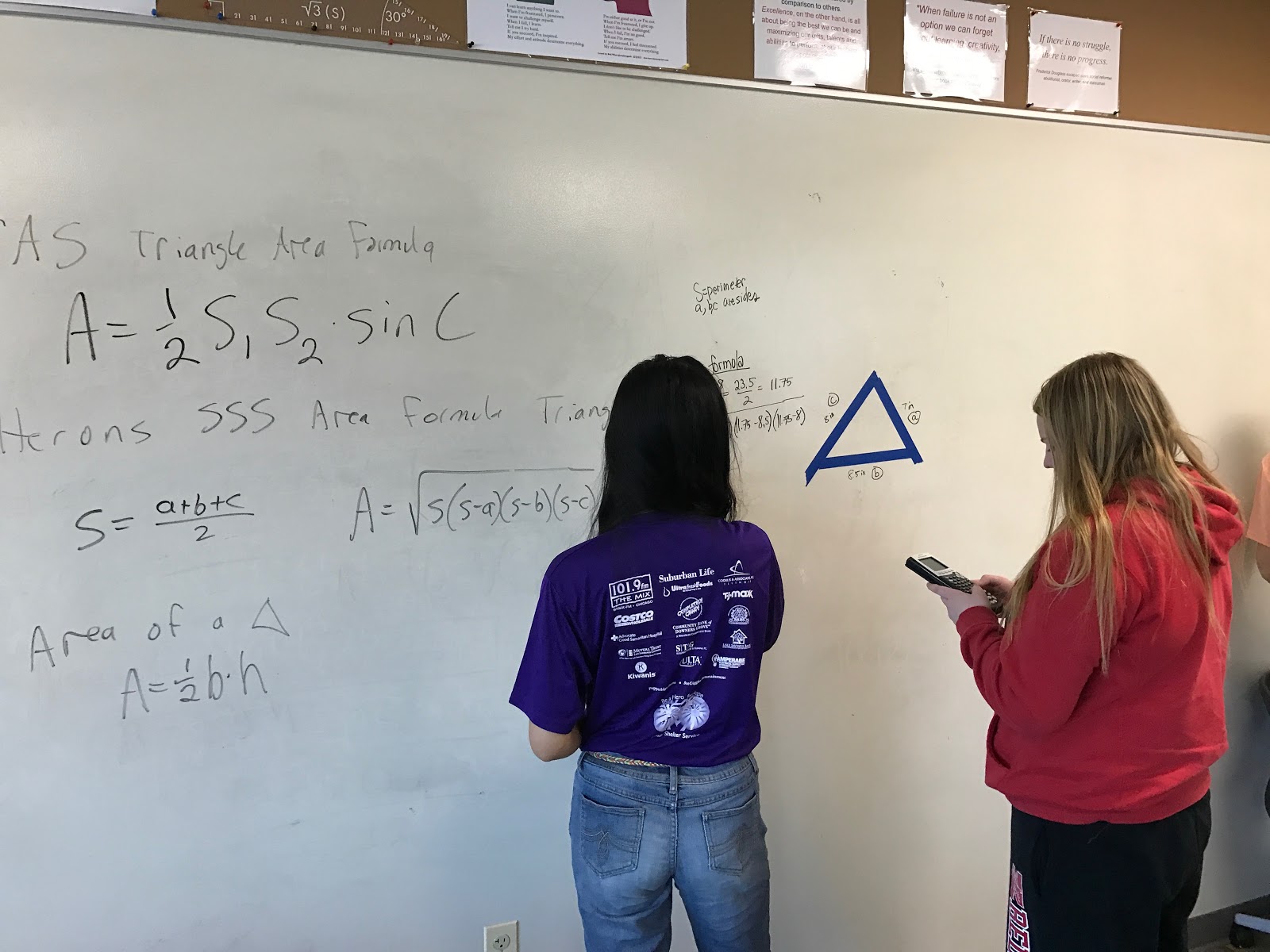
This project students created their own non-right triangle and then found the area of it using 3 different formulas.  #precalculus 

This group had a "random triangle that turned out to be an equilateral triangle.  They called the PERFECT triangle.  They were proud.


In this project students are making shapes to understand quadratics. This was in Algebra 1.  A colleague @rachelfruin and I wrote this  if you are interested, here is the progression.   


Try Blue Tape Math with your colleagues in the office.  We did.  It was a great experience.  @rachelfruin  @smiller229 and @mthor_  all have been working on blue tape math together.  The best way to describe what happens when you are using blue tape to get at a solution is that the process is 'slowed down'.  It helps everyone collaborate together at the same pace.  Try it in your office, and then try it in your classroom.  

Take the Blue Tape Math Challenge 

Find one or two colleagues that are up for an adventure, and create a regular pentagon with only a ruler, protractor, and some blue masking tape.  You can create the regular pentagon on the floor, desk or wall.  At the end of your creation reflect on the things you needed to accomplish the task.  Then discuss how you might use blue tape math in your class.  If you have time, let us know what you think @rachelfruin  @smiller229 and @mthor_ @dsladkey


A Word of Caution.  

Your lesson is going to take a lot longer.  This was something that was frustrating at first, but I realized that sometimes when a problem takes longer, the students understand it more thoroughly.   Another word of caution is that I always measure the figure on the INSIDE.  It has much crisper lines.  Also, I have my students use 1/4  inch blue tape.  See below.


#bluetapemath  


Saturday, February 28, 2015

Sometimes UN-Simplified is Better

To Simplify or Not to Simplify, that is a good question.


Recently, I have not been simplifying my work.  Let me explain.  We have been working on finding the equations of sine graphs in Precalculus.  I have found that when I type out my work in Desmos it doesn't automatically simplify it.  It still graphs it.  You can see the changes as you type them in.
This is really cool.  It leaves it so that the students can think about how the numbers came to be.  It is almost formula like.   See below.
 

Then, I asked my students to simplify the equation so that we can gain meaning out of the numbers.


Here is the project we just finished with if you are interested in taking a look. It is a project where we look at the vertical height of a person on a swing.  There is data involved and then we have to find the correct sine wave.   http://tinyurl.com/swingdesmos


Here is another place that I see non-simplification as a perfect fit.  In linear equations using slope. You can see here it fits right into the slope formula.  This also shows equivalencies of linear equations.   So if you make a mistake on one simplification step, you will see it right away because it will not match up with the first one.

Actually, I think that when we show our steps in this way we are "digitally showing our work."  Hope you can give it a try.

Best,
Dave


Friday, February 21, 2014

Making a Face with DESMOS.com

If you haven't worked with desmos yet, you are missing out.  It is so easy and intuitive.  The students will catch on so easily.  Here is the in class assignment I gave today.  This was a precalculus class.  You can easily adjust this for any high school math class.

This was a student's work was done in 15 minutes of class time.  There is so much math here too.  
  

Sign up with desmos.com and make a face using the free online calculator.

Your face must include these things:
1.  A circle or ellipse
2.  A line
3.  A sin or cos wave
4.  A slider
5.  A parabola
Now post your face in a link to this website:  http://tinyurl.com/nchsprecalculus6

Please go to this site to see all the wonderful examples that my students made.  They will make you smile.

Here are some questions that I had today.
How do you make the sin wave go vertical instead of sideways?
How do you move the circle from the center?
How do you restrict the x values so they don't always show?
How do you make a circle bigger?
How do I make this parabola wider?

Take 15 minutes and make a face today and you will see how much math DESMOS has.  Now this was a fun class.  The students were really active in their pursuit of the math topics. Please try this and let me know how it goes.
Dave


Tuesday, April 2, 2013

Triangle Challenge: The Ambiguous Case Explored using Pipe Cleaners


I have always had trouble with teaching the Ambiguous Case.  It seemed that whatever I did, the explanation was not good enough.  The kids came out of my class with their heads exploding with all the things they had to remember.  A couple colleagues and I created a hands-on activity that really explores the heart of the ambiguous case and the Law of Sines SSA example.  After going through this lesson, I really feel like the students had a grasp on the ambiguous case conceptually.  My work is not finished, because I have to now finish the procedural process and we should be good..  The first video is the explanation of the original challenge.  The second and third videos where students explain their partial and full answers.

Triangle Challenge Rules and Guidelines   SMARTBoard Notebook Lesson      PDF Lesson
1.  Use one pipe cleaner that is 8 inches long (light colored) and put it as side two

2.  Angle A is exactly 30 degrees.
3.  Side one is a second pipe cleaner (darker color) and starts at 12 inches long.  It can be shortened by 1 inch increments.
4.  Create as many triangles as you can using the above restrictions.
5.  Hint:  There are more than 10 solutions.


The Challenge


A Student's Partial Solution

A Student's Full Solution

An interesting Solution


PIPE CLEANERS ARE A MUST FOR PRECALCULUS CLASS! See another blog post using pipe cleaners click here.

CLICK HERE FOR THE SMARTBOARD LESSON  (use must have notebook software to view this)

CLICK HERE FOR THE PDF LESSON 

Happy Ambiguous Case Days ahead!!
Best,
Dave


Thursday, October 20, 2011

I AM A ...Stand Up, Auditory, Randomly Chosen Students Activity

1.  Have your students stand up.
2.  Have 5 "I am a..." questions ready to ask.  (I have given you a few examples below)
3.  Tell the students that they are not to shout out answers for this activity.  They should think of the answer and be ready to give it when called on.  
4.  Explain to your students that you will be calling students at random for the answer.  Also explain that they will be doing this completely by listening to the question.  They will not be allowed to write out anything.
5.  Give the question and then give the students some "think" time before you call on someone. 
6.  Call on someone to answer the question.  Have them justify the answer.
7.  Call a new person to verify or change the answer.   Do this until you get 2 people in a row to verify an answer. 
8.  Verify the answer yourself and then move to the next question.

It is a great lesson on LISTENING and MENTAL MATH.  It only takes a couple of minutes and the students like it.   You get a high involvement rate because you are being called on at random. This is an activity that I do not assess.  It is also a great review session that breaks up the regular day.  Give it a try and let me know what you think.

All the Best,
Dave

See the examples below.

Intro to Algebra Area and Perimeter


Algebra


Intro to Algebra Fractions


 Precalculus Polynomials