Showing posts with label move and learn. Show all posts

Monday, August 24, 2020

Students Still Need to Move: 9 Brain Breaks to Help Zoom Fatigue

Zoom Fatigue?  Students still need to move.  Maybe more than ever we need to encourage students to get up and move around during their online learning.  A little break in the middle of your lesson or video or slide presentation would help.  I'm planning on giving one brain break per class period.

Here are some ideas of how to use a brain break in remote learning.

  • In the midst of your lesson via Google Meet or Zoom time, put in a brain break slide. I have included 9 different of my favorite Brain Breaks in slide form.  Do you present with SmartBoard or PowerPoint or Google Slides?  Each of the following files have 9 Brain Breaks with video explanations. (Link to SmartBoard, PowerPoint or Google Slides Click Here)
  • In the middle of a video you have put together for your students, pause and ask your students to stand and walk through a brain break with you.  
  • Do you have a Learning Management System (LMS)?  Put a module in for a Brain Break.
  • Zoom Time:  I have included a few partner brain breaks below.  Explain the Brain Break (or show the video)  Then separate your students into breakout rooms of 3-4 students each and give them 2 minutes to do the Brain Break.  

Here are 9 of my favorites


These are partner brain breaks.  I would suggest using breakout rooms in Zoom.


 Feel free to download any of these 

Google Slides:  A Few Energizing Brain Breaks

PowerPoint: A Few Energizing Brain Breaks

SmartBoard: A Few Energizing Brain Breaks


Energizing Brain Breaks by David Sladkey


http://www.energizingbrainbreaks.com/


https://us.corwin.com/en-us/nam/book/energizing-brain-breaks


Energizing Brain Breaks on Amazon

More Energizing Brain Breaks by Scott Miller


https://us.corwin.com/en-us/nam/more-energizing-brain-breaks/book271479

More Energizing Brain Breaks on Amazon


Friday, October 27, 2017

Pass It On! Linear Modeling Activity

Do you want your students to be engaged?  Do you want them to make predictions?  Do you want them to Move and Learn?  Are you working with linear equations?  Try this activity in Algebra 1.

Pass It On Book Passing Activity
Students will be passing 4 textbooks around the room in a established pattern. (see picture)  The number of students that pass the books will be determined and then the length of time will be noted.    (number of students passing the books, time to pass books) = (x,y)    Predictions will be made for the x and y unknowns.


Explain the outline of the activity.
Assign a timer.
Assign a note taker to record the data. (in a google sheet with a common link preferably)
Establish a pattern for passing the books.

Establish a short (approximate 10 second) routine for BEFORE the books are passed.  (jumping jacks, twirls, stacking books one by one, etc. This is to establish some type of y-intercept for the problem) See the video.

Practice passing the books around the path to make before timing the events.


Now time your class doing 3 people, 8 people, 14 people and 21 people.  
Record the data in a Google Sheet.  Here is our data from our class:  http://tinyurl.com/racingthetime 
The data is below: these coordinates are in (# of people moving the books, time) = (x,y)
(3 people , 11.17 seconds)
(8 people, 17.4 seconds)
(14 people, 25.4 seconds)
(21 people, 34.67 seconds)

MAKE PREDICTIONS
Get your class into groups of three and ask these two questions.  
How long will it take for the books be moved by 30 people?  
(30 people, ? seconds)
If it took 73 seconds to move the books, how many students did the moving? 
(? people, 73 seconds)


I had the groups put their predictions in the google sheet that was created for the data.  
Lastly have your class actually test the predictions by measuring for 30 people and 73 seconds.  It was a lot of fun to find out the actual time for 30 people and the actual amount of people for 73 seconds.  The students were really into it.  

Good questions to ask 
What does the slope mean?
What does the y-intercept mean?
What methods could be used to predict your answers?

Hope you can give this a try.
My Best,
Dave


Tuesday, May 23, 2017

Blue Tape Math

What is Blue Tape Math?  

Simply put, it is having your students use blue masking tape to represent math on the wall, floor desk or windows.  


Why use Blue Tape in Math?

MATH:  Students are using ratios, scale models, fractions, decimals and graphs ALL THE TIME.  Blue masking tape also 'slows' the math down a little bit so all can jump in and be engaged.
MOVEMENT:  Students are moving while learning which helps our kinesthetic learners.
MEASURING:  Students are using rulers, protractors, tape measures.
AND NO MESS with painters masking tape.  It comes right off of walls, glass, desks and floors.


Math Skills

Ratios
Scale Models
Measuring an angle
Measuring a side length
Fractions (While measuring distances)
Graphing
Areas


Where can students create their shapes?

Walls, Windows, Floors or on the Desks.

Ideas for when to use blue tape

Create a figure with a specified area.
Create a regular hexagon or pentagon.
Create parallel lines, or parallel lines by using a traversal
Create a parabola from a quadratic function.
Create a kite.
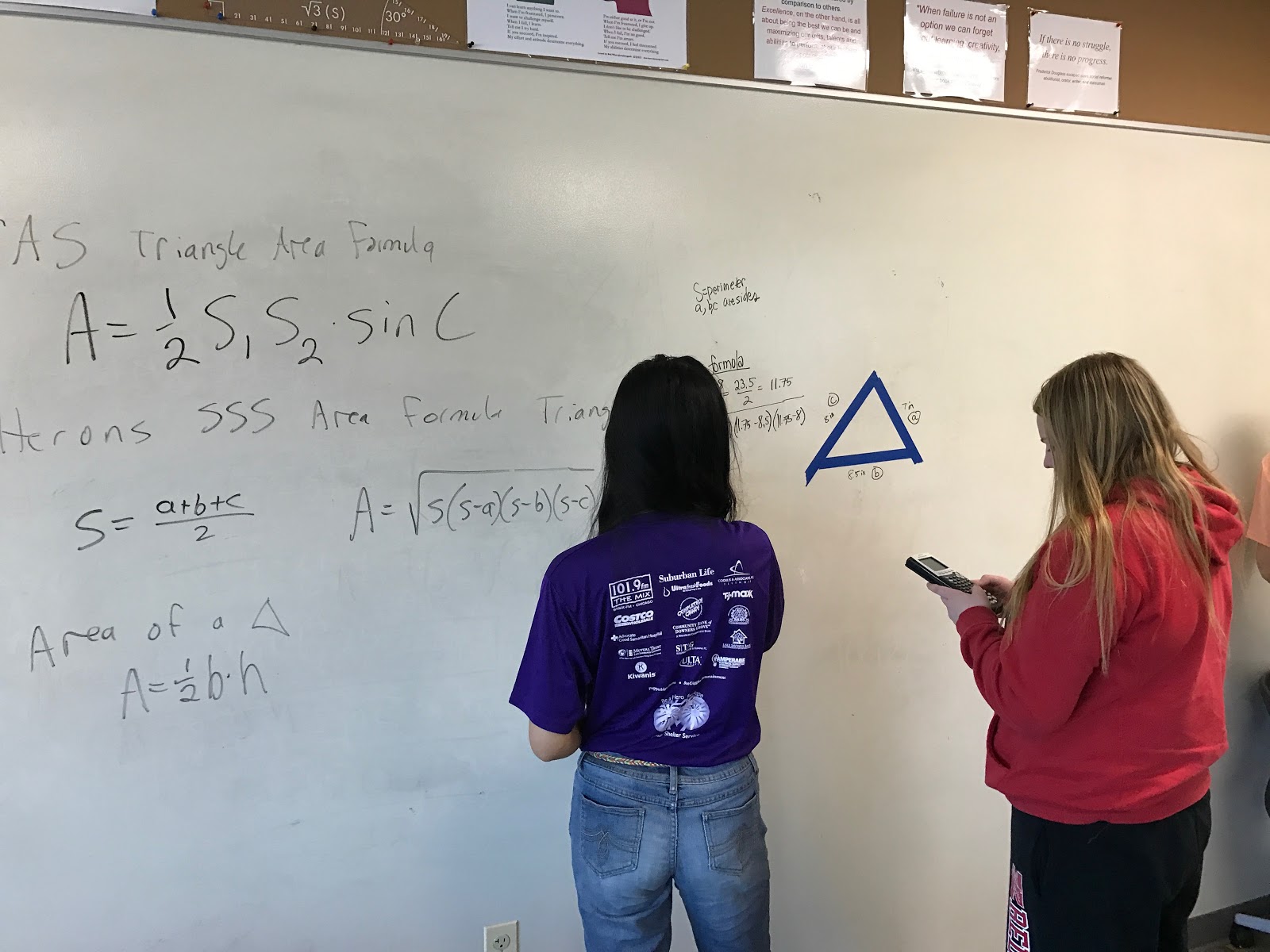
Create a triangle with Blue Tape.  Find the area of this triangle in multiple ways.
Create a shape (triangle, quadrilateral, etc. ) .  Create a different shape with the same area or perimeter.
Create a circle using blue tape.  Now guess how many diameters will be needed to make the circle?  Test your guess by creating diameters to go all the way around the circle.
Quadratic expressions and equations.  Click to get to the activity we did in class.

This project students created their own non-right triangle and then found the area of it using 3 different formulas.  #precalculus 

This group had a "random triangle that turned out to be an equilateral triangle.  They called the PERFECT triangle.  They were proud.


In this project students are making shapes to understand quadratics. This was in Algebra 1.  A colleague @rachelfruin and I wrote this  if you are interested, here is the progression.   


Try Blue Tape Math with your colleagues in the office.  We did.  It was a great experience.  @rachelfruin  @smiller229 and @mthor_  all have been working on blue tape math together.  The best way to describe what happens when you are using blue tape to get at a solution is that the process is 'slowed down'.  It helps everyone collaborate together at the same pace.  Try it in your office, and then try it in your classroom.  

Take the Blue Tape Math Challenge 

Find one or two colleagues that are up for an adventure, and create a regular pentagon with only a ruler, protractor, and some blue masking tape.  You can create the regular pentagon on the floor, desk or wall.  At the end of your creation reflect on the things you needed to accomplish the task.  Then discuss how you might use blue tape math in your class.  If you have time, let us know what you think @rachelfruin  @smiller229 and @mthor_ @dsladkey


A Word of Caution.  

Your lesson is going to take a lot longer.  This was something that was frustrating at first, but I realized that sometimes when a problem takes longer, the students understand it more thoroughly.   Another word of caution is that I always measure the figure on the INSIDE.  It has much crisper lines.  Also, I have my students use 1/4  inch blue tape.  See below.


#bluetapemath  


Monday, April 29, 2013

Graphing Polar Coordinates with your FEET. Move and Learn!

This video demonstrates students plotting polar coordinates by actually moving their feet. It's just another way to move and learn. When you physically plot the point with your feet it cements the process in your mind. Use blue masking tape on the ground and plot some points with your students. It's as easy as that. 

The students are plotting the point (3, 150 degrees) on the ground.  They found out another way to plot it was (3, -210 degrees)


I would you encourage you to buy some blue tape and plot ANY type of point or graph with FEET!  You will be amazed at the retention that your students will have.

Want more move and learn?  www.learningreadinesspe.com