Showing posts with label problem solving. Show all posts

Monday, December 20, 2021

The Magic of Students Doing Challenging Questions in Groups of Three on Vertical Surfaces in the Math Classroom

I read Peter Liljedahl's book Building Thinking Classrooms in Mathematics  this past summer and it has been transformational in my teaching. Getting all my students to go to a vertical surface in groups of three has been MAGICAL!!!!  I absolutely love the idea of students thinking more on their own than myself blabbing on about the material.  Brilliant!   It is a must read that is appropriately called the #thinkingclassroom. Let me give you major things that I changed in my classroom this year.  

1.  Select RANDOM Groups of Three 

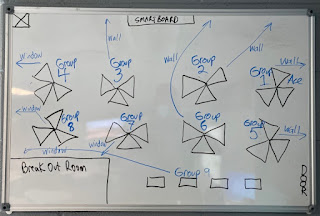
The first thing is the randomness of your groups.  This is important because groups get old fast.  If a student has the opportunity to work in a new group of students they are more apt to participate and give and take instruction with their peers.  I change groups every time I have students go to the vertical surfaces which is about 3 times a week.  I hand a deck of cards to a student and they are in charge of shuffling the cards and then passing them out. See the video below.  Now before you hand the student the deck of cards you have to make sure there are the right amount of cards for the students.  I actually have 5 sets of cards, one for each class.  Then I don't have to mess with it too much because of absences.   I then have different locations that the Aces would go to, and the two's would go to and so on.  (see the image on point 2)   The deck of cards help the students know that it is not you that is making the groups.  After they get into the groups with all their stuff, this is the seat and location for the rest of the day.    Also, groups of three is perfect.  Two is too little and four is too much, three is just perfect.



2.  Have all Groups go to a Vertical Surface

This is tricky because you will need up to 8-10 spots in the room where students can do problems.  I use the wall which have white board paint on it.  I also use my windows which create a perfect surface to write on.   Sometimes teachers buy a 4 foot by 8 foot white board panel at Home Depot and cut it up and put it on the walls.  There is such a thing as plastic whiteboard sheets that cling or stick to the wall that work as well.  Since the students are switching groups locations so much I put a small group location map on the wall for students to navigate every time we change groups.    


3.  Give Challenging Problems.

In previous years, I usually would build up to problems that were more difficult with students.  However, I ended up not doing the most difficult ones because of time.  So start with the challenging ones first and you set a standard right away with vertical surface problems that will be difficult but reachable.  If you start with a challenging question, the process usually flushes out other easier concepts that are needed in the lesson.  Also, it is good for students to be stuck and figure out how to proceed.  This is what Liljedahl calls PROBLEM SOLVING!  What do you do when you don't know what to do.  So many times we take the challenging part out of their work and we as teachers do it for them.  Let them be challenged and think on their own.  Lastly, try to give open ended questions.  For instance, create an equation of a line that has an x-intercept of (0,5) and only passes through quadrants I, II, and IV instead of a question like find the equation of a line through these certain two points.



4.  How to Deal with Questions?

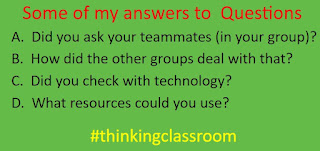
I think you better read Peter Liljedahl's book for this question.  However, the one thing I have learned so far this year is that I try to redirect questions back at their teammates (their other group members).    This gives power back to the group.  I have found that I know when students are just looking for confirmation or when they really need to know how to proceed.  When a student asks me if something is correct, I don't directly answer that.  I tell them to check with their teammates or to look at what other groups around them have done.  This is a good way to get dialog happening because many times other groups will have a variety of answers so students have to decide how to proceed.  Liljedahl has a list of excellent replies to questions.  See below.  I refresh myself with this list all the time.  My favorite is how did you do that? 


5.  Only one Whiteboard Marker per Group and Change 'Writers'

Only allow one pen per group.  This forces collaboration.  Also, make sure you call out for students to change who is writing the problem down on the board.  Sometimes groups change on their own, but more often I've found that you need to call out the change.  Sometimes I have a timer on my phone and it rings every 1-2 minutes for a change of writer.   This time amount always depends on the problem.  The non-writers are encouraged to bring their spiral (blank paper) up to the vertical surface to write notes with.   


Benefits to Vertical Problems
  • Math talk is huge...even 1st period.
  • Movement in the classroom.  
  • Students are willing to take math risks with new group members
  • Mistakes are easily changed via dry erase.
  • Students love to write on the wall
  • Class collaboration because groups can all see how all the other groups are doing the problem.
  • Did I say math talk?  Huge!!
  • Students like to take pictures of their work for future reference

Challenges to Vertical Problems
  • Some students are not collaborative and thus do not help their teammates. 
  • Off task groups 
  • Students don't always write down the problems/solution.  Thus they don't have notes from their work on the vertical surface.


Tuesday, July 31, 2018

The Struggle is Real: Devoting 20 Percent of Class Time to Problem Solving

I want my students to struggle--to squirm and to be frustrated.  I often struggle with math questions. It takes me a while to process and sort out my thinking.  Struggling with a math problem gives me confidence for the next one.  In the classroom I love when my students are working on a difficult math question and then someone has an ‘aha’ moment.  It is like someone receiving a clue to the location of a hidden treasure.  It spurs others to continue working and finding other connections. I want them to take ownership and celebrate the journey.  I could sum up my teaching philosophy with the phrase, "I want my students in a productive struggle."  I want my students to struggle, but I want them to be productive in that quest.  If the struggle is too easy or too tough, then I need to help make some adjustments by creating the right environment and finding the right questions to problem solve.  That is why I'm trying 20% Struggle Time.


20% Struggle Time (Problem Solving)
My instructional learning coach  Chris DeWald from BetterLesson recently challenged me.  "Why don't you devote 20% of your class time to (productive struggle) problem solving questions?"  I have accepted the challenge and I've been on this journey since late last year. I'm taking 20% of my class time and devoting it towards problem solving, and not necessarily content-based problem solving either.  As far as actual time in the classroom that means 1 day a week or two half days a week we will be in a productive struggle solving problems.  It has been fun and really rewarding--and frustrating.  It is all about finding the right problems and creating the right atmosphere for learning. 

Easy Problems Do Not Accomplish Much
You know what an easy problem is.... the ones that you don't have to think too much to solve.  If you don't have to think too much to solve something, you probably won't remember too much about your work, nor will you be satisfied with yourself.   I tend to give out too many easy problems.  My lesson will include some kind of formula and the problems use the formula--too easy and too forgettable.  Fawn Nguyen says, “Are they really ‘problems’ if we know how to solve them?”  I firmly believe this.  


Problem Solving creates productive struggle.  I'm not talking about word problems at the end of each section of practice problems.  I'm talking about NON-Content Specific Problem Solving.  The problems students can't just look up in their notes and see one almost exactly like the one given.  A problem that they can solve, but it will take time and maybe more than one class period.  It will take reflection of possible solutions.  It might even take some research, or multiple attempts at the problem, or scaffolding from the teacher or other classmates.


What does 20% Struggle Time look like when Problem Solving?
1.  I have a walk that I take often that leads me under a canopy of oak trees.  Students need to feel like they are in a canopy of oak trees—a safety net.  They need to know that the students around them and especially myself as the teacher are WITH them.   A positive classroom atmosphere creates safety nets in case they don't get it.  Examples of safety nets would be: formative testing without grade impact, retakes on summatives, daily work that explores but does not affect final grades, classmates who are willing to help others, and a teacher who offers multiple avenues for help.

2.  Finding the right problems is important--Inviting and Approachable Problems with Escalating Difficulty (Low Floor High Ceiling).  Everyone has a different threshold of pain.  Some complain wildly because of a small cut, and others would not be fazed by a large gash.  That is just how we are made.  Accordingly, I believe we all have a different threshold of struggle.  For instance, some people might look into a problem with their laptop with bitter frustration and give up quickly, while another might struggle for a long period of time.   It is the same thing with a problem in math class, some students look at the problem and then give up quickly.  Other students look at the problem and start formulating some ideas.  The trick is to find questions that anyone can start and yet most will be challenged at some point in the problem.  Here are some of my 'goto' problems. 

There are actual examples at the bottom of the post

3.  I’m still working out how to approach grading Productive Struggle. Is my 20% struggle time a completion grade?  Do I grade on correctness?  Should there be a rubric?  Maybe I should just build in accountability with group presentations of thinking?  Any thoughts or suggestions on this would be welcome!!

Plumbing and my Father-in-Law
Confidence solving problems is a real world skill.  When we had just bought our first house, my father-in-law and I were looking into the electrical box to see how to stop one of the circuit breakers from going off regularly.  It was a nest of confusing wires.  I asked him how he felt so confident that he could figure this out.  I was ready to give up.  He said, "Whatever mess I get myself into, I’ll just keep trying to figure the problem out by taking a generous amount of time and many setbacks trying to prevail. A last resort solution would be that I could hire someone to fix it." I have used this advice often and have learned that with determination and confidence, I can often see it through.  Like every year when I do my taxes. I can usually figure out most questions (with Turbo Tax).  This is the attitude that I want my students to come out of my class with.  I want them to be confident that they can attempt and find a method of solution with almost anything they encounter and that it will be a productive struggle.  My father-in-law without knowing it, was using the Mathematical Practice Number 1.  I'm hoping that 20% Struggle Time will help my students with this mindset.


Teach Before or After They Need It?
My wife will never let me teach her about any technology until she needs it.  Why?  Because she says she will forget it all and then just have to ask me again when she actually does need it.  We need to give the problem first and then our students will need to use the skills and formulas to get the answer.  That is true problem solving. Sometimes our classrooms are backwards in that we do all this upfront teaching so that they will remember it when they need it.  Which by the way, rarely happens. Needing it might mean that it might be on a quiz that happens a couple days after they learned it so that you can just memorize the steps to get through.  Introducing 20% struggle problems will help exercise the GROWTH MINDSET needed to solve new challenging problems that they have never seen before.

What about the Content?
Some would argue that they don't have enough time to teach the content now, how are they going to introduce more problems?  I get that.  However, I believe math is an attitude not a skill.  We really are teaching our students to have GRIT, to never give up, to exhaust all resources, to struggle, and to fail.  We can teach skills until our students are robots or we can teach them to be real world problem solvers.   

The Struggle is Real, so that is why I'm going on the 20% struggle time journey.  I'll keep you posted.  I welcome any thoughts or advice.

My Best,
Dave
A Visual Pattern Task    Here is a collection of a few that I've made


The Toothpick Task