Showing posts with label math. Show all posts

Monday, March 18, 2019

TRUTH or SNARE: A Math Equivalence Game


TRUTH means equivalent
SNARE means not-equivalent (but really close) 


This game is the reverse of a Number Talk.  In a number talk the teacher gives a problem and students find different ways to come up with the answer.  With TRUTH or SNARE, the teacher gives an answer and the students create potential equivalent possibilities (truths) or non-equivalent possibilities (snares).  The rest of the class has to find ways to determine if the possibilities are a truth or snare.

Let's give an example

Teacher:  Let's play TRUTH or SNARE with the theme being exponents and order of operations.  Remember that SNARES are NOT-EQUIVALENT but are really close to being equivalent and very tricky.  Create at least 2 TRUTHS and 2 SNARES for the following answer:  16      (Teachers resist the urge to give examples.  Don't do it.  Instead, encourage the students to create a problem that has an answer of 16.  Remind the students that it won't matter if their problem is equivalent or non-equivalent...they will not be wrong)

Students:  Work in groups of 2-4 to accomplish the task.  (Teachers  make sure each group has at least one example of either kind)

Teacher:  Pick groups at random to present their possibility.  Students will not be telling the rest of the class if it is a truth or snare yet.   Have the groups put their problem on the board or have the group give them to the teacher to put on the board.

Teacher:  Now take some time in your groups to decide which ones are TRUTHS or which ones are SNARES.  (Allow enough time for all groups to get through at least half of the examples given)

Students:  Work together in your group or with your partner to determine if each problem is a TRUTH or a SNARE.  Be ready to defend your work.

Class Discussion: Take a vote for each example.  Thumbs Up (Truth), Thumbs Down (Snare), and Thumbs Middle (Unsure).  (see my voting thumb pictures below)  Have students walk through the reasoning and or the teacher walk through the reasoning for each example.  Be open about the fact that this activity is meant to push your understanding and that you might make mistakes on what is a TRUTH or SNARE.  These mistakes are helpful for us to recognize equivalencies in the future.

See the example below that we did in class.

Here are a few examples of what the students made.

Group B,C and D are TRUTHS and A and E are SNARES.


The beauty of the game is that students do not fear creating a wrong answer.  Actually, they like to create answers that are SNARES.  Students like to trick their classmates.  


Here are some other examples that we have done.


This is what I have been doing when I have my students voting.


This game is a work in progress.  Do you have any suggestions for me?  What has worked for you?  Please let me know.

Friday, July 31, 2015

The FIRST THREE DAYS of Class

The First Three Days of Class


  1. Parable of the two golfers
                    Click Here


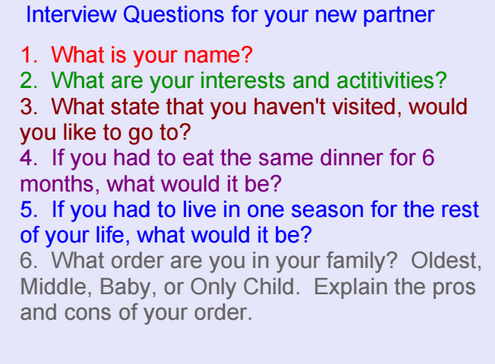
  1. Student Partner Interviews
Place students with the new Seating Chart.     Have students interview their new partner
Share out the interviews by introducing your partner to the rest of the class and answering 2 or 3 of the questions.


  1. Partner List


This list will be used when are working in cooperative learning groups.  Click here to access it.  

  1. GRIT Discussion


Take the GRIT SCALE Quiz:  https://sasupenn.qualtrics.com/jfe/form/SV_06f6QSOS2pZW9qR  or http://tinyurl.com/quizgrit    If you want to look at the questions again click here.  Or go to http://tinyurl.com/gritquestions


  1. Brain Break

  1. Estimation 180
How many Almonds in the cup?
2598119.jpg

  1. Desmos Sign Up


Make a design using desmos.  There is a lot of math involved here.  Use the help button for tutorials.  Here are some examples https://www.desmos.com/art
Spend at least 20 minutes trying to make a design.   Save and name your design. Get the url.  (use the share button) Post the url at


Period 1:  http://padlet.com/dsladkey/period1desmosdesign


  1. Google Drive Setup
Create your folders like this in your main drive…..
__School Misc
_Home Misc
_P1 Algebra 15-16
_P2 French 15-16
_P3 Anthropology 15-16
...
Clubs_Sports_Activites
Pictures and Videos
Z_Catch All


Color Them as you wish


_P1 Algebra 15-16
_Assignments and Projects
_Class Notes
_Important Class Stuff        passwords might be in here
Desmos
Geogebra
Pictures and Videos
Screenshots


  1. Brain Break


Get in pairs.  Decide who is person A and who is person B.

Person A starts and asks Person B a question from below.  After the discussion, then person B asks Person A THE NEXT QUESTION and so on.  
  • Who is responsible for the device – what does that entail?
  • Discuss the idea of passwords and password literacies
  • Decorating of devices?
  • When can they be on social media and communicating with others?
  • Consequences of off-task behavior in class
  • Limits on personal work on device
  • Charging of devices

Pick a free space in the appropriate document below to give your thoughts on one or more of the above topics.


  1. All are True Except One
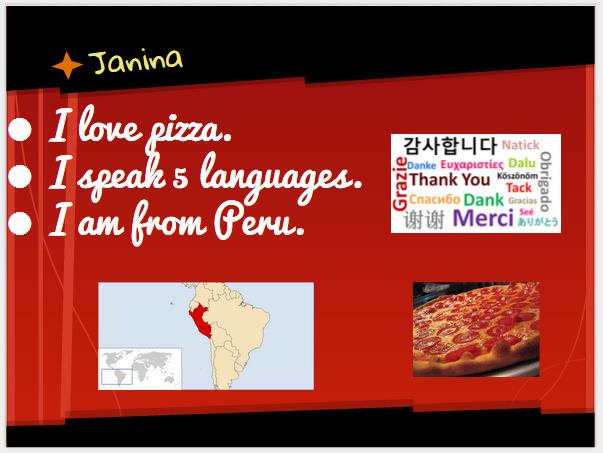
Go to the Google Slides document below and make a Slide that represents you.  Make all the things you say to be true except one.
Period 1     Period 2      Period 4     Period 6


  1. Differentiated Instruction
Dollar Bill Activity:  Invite someone to get the $1 from taped to the high part of the wall.  Then ask a person who can’t reach it to try to get it, then ask a taller person to get it.  Discuss the implications for this as we try to work together to learn more math.


Learning Style Quiz


Meet with your favorite food partner and discuss the following quote.


Quote 1:  ” ‘differentiated instruction’ refers to a systematic approach to planning curriculum and instruction for academically diverse learners.  It is a way of thinking about the classroom with the dual goals of honoring each student’s learning needs and maximizing each student’s learning capacity.”
-Carol Ann Tomlinson and Cindy Strickland


Quote 2:  
  1. Brain Break


  1. Mindset Quotes  
Read to yourself the Mindset Quotes.  3 minutes.  Which one do you identify the most with.  Why?  Now meet with your group of 4 and have each person discuss the quote they most identify with.


  1. Importance Order Smartboard Activity


  1. SMARTBoard Rules Activity


  1. Homework Expectations
Use Socrative to get opinions on what homework expectations should be.  We will build the homework framework off of these.


  1. Goals Google Form


Click here to get to the Google Form to submit your Goals.

Below is what it looks like.


Friday, December 12, 2014

Give Meaning to Numbers with Technology

A colleague and I were talking about math problems a few days ago.  He told me that he really likes to give meaning to numbers because it helps the students put the numbers in context.  I completely agree. We were working on percents at the time in my Introduction to Algebra class so I decided to give a little more meaning to my percentages.  Here is what I did.


Since my students have laptops,  I had them go to Kohls.com and pick out an item that they liked. They got to choose a 15% off, 20% off, or 30% off coupon.  (I thought they all would pick the 30% coupon too, but they didn't)  Take the price of that item and reduce it by the coupon amount.  Then they were asked to add on 8% tax.  Lastly they had to post their work to a padlet.com site where all could see their work.  You can see their work too: http://padlet.com/dsladkey/kohls  Padlet is a great tool for student collaboration.  www.padlet.com   


Here is the progression of the assignment
1.  Find an item at Khols.com  Find the price.  (even if it is already discounted)
2.  Choose a 15% or 20% or 30% off coupon.
3.  Reduce the price by the amount on the coupon.
4.  Take the new price and add 8% tax to it.  
5.  Show your picture and all your work on a common padlet site for all to see.  http://padlet.com/dsladkey/kohls


What were the big takeaways?
1.  They learned the material without a bunch of problems without meaning.
2.  Choice.  It gave students a choice for what they wanted to work on.
3.  Pride.  When we shared these out, there was a lot of pride happening.
4.  Recall.  A student asked a question on the test and I just said "Do you remember what you did with the Kohl's activity" and they said, "Oh yeah"
5.  Engagement.  This activity took about one 50 minute period. They were diligently working the whole time.
6.  Accountability.  All students could see all the posts.

Dave
@dsladkey

Friday, June 28, 2013

Just DO MATH!


Do MATH!  This summer I keep on thinking how I want my students to do math.  Actually DO MATH.  Meaning I want them to use their hands to explore and accomplish MATH.  I want them to measure with a ruler or tape measure.  I want them to use a protractor.  I want them to investigate with some actual data that they have collected.  I want them to construct.  I want them to cut and paste.  I want them to use pipe cleaners.  I want them to use Wikistix to create a graph.  They should be actually constructing something and numbers should be going through their heads.

Let me give you two phrases and you choose the one you like the best.
1.  Regurgitate math
2.  Experience math
Exactly.  I would choose 2 also.  But what do we make our students choose time and time again? Yep, #1.  

Here is the origin of this idea Do MATH.  Last spring I had my Precalculus students use a 30-60-90 triangle in a video.  Basically they had to construct a 30-60-90 triangle to help them explain some other concept that we were covering. Interestingly, the students didn't have any trouble with the concept we were covering but they did have major questions of "How do I make a 30-60-90 triangle?"  This was just mind-boggling to me.  These are the students who could tell you the exact distances of each side of a 30-60-90 triangle for just about any length of any side.  Now they wanted to know how to construct it?  Well, I had to rethink my own teaching.  Have I ever taught them how to make a 30-60-90 triangle?  Have they ever had the practical end of the trigonometry?  So I realized that my students are not at fault.  I AM AT FAULT!!!!!  I need to have my students DO MATH.  I will make time because I don't want my students to walk out of my class without some practical knowledge of their math instead of just theory.


WikiStix
Here are the ideas that I have been thinking about.  I have included the level for when this might be covered. You will notice there are a lot of Introduction to Algebra and Precalculus Ideas.  That is what I'm teaching now.
1.  Precalculus:  Construct a 30-60-90 triangle with cardboard or some other material.  One side must be at least 10 inches.   Justify in two ways that you know this is exactly a 30-60-90 triangle.    Others:  Construct a 45-45-90 triangle.
2.  Introduction to Algebra:  Build a Balance Scale.  Use any materials needed for the project.  You will be using pennies as your "weights".  You will be required to show the penny weight of a few different objects.  Notes:  I see this as an important link in how to solve equations.  This scale could be used when solving different equations.
3.  Introduction to Algebra:  Create a number line on the floor with blue masking tape.  You should mark out the numbers from -5 to 5.  Each number should have 10.5 inches between them.  You will be using these to add and subtract integers by standing up and moving to a problem.
4.  Precalculus:  Make a WikiStix parabola.  You must make it to be at least 15 inches in one direction.  You must be ready to justify why you know this is a parabola.   You must give the equation for the parabola.
Other ideas:  Create a sine graph. Create a  tangent graph.
5.  Introduction to Algebra:  Create a circle and  rectangle that have exactly 50 square inches of area inside.
6.  Precalculus:  Create a WikiStix triangle that shows how the ambiguous case is solved.


I have so many questions about this.
1.  Should I have a DO MATH day?  This might take up the whole class period.
2.  Should I have a DO MATH segment?  This would take up only a 15 minute class segment.
3.  How often should this happen?  Once a week?  Once a month?
4.  Ideas?  I definitely would need some ideas for this to occur.  See below for my short list.  Please comment and add to them.

All the Best,
Dave

Wednesday, April 25, 2012

What would YOU like to see in a Digital Math Textbook?

Our department is looking into writing our own digital textbook.   Whenever we adopt a new textbook it seems like we rewrite it anyway.  Why not write it ourselves.  So we discussed the question:  "What would you like to see in a digital textbook?"   Please add to the list by giving a comment.


1.  Levels of examples

2.   Video examples

3.   Video lessons

4.   Assessment tool

5.  Homework problems easily printable

6.  Link for students to access SMARTBoard notes

7.  Geogebra/sketchpad/fathom activities

8.  Wikipedia like edits

9.  Accessibility (all browsers, phones, etc)

10.  Interactive Practice

11.  Homework submission

12.  Dynamic charts

13.  Exploratory features

14.  Tutorials

15.  Plenty of practice problems

16.  Online quizzes with built in mastery and explanation of correct answer

17.  Test generator-choose questions by standards. Alternate questions

18.  Students can highlight sections, annotate on-line, and drag and drop main ideas to make a study guide.

19.  Targets generator with tutorial

20.  Reference to Google tutorial topics

21.  Aleks like account

22.  Shows only the problems that the teacher wants to give.

23.  Dynamic and up to date

24.  Immediate feedback on practice

25.  Printable Homework

26.  Grades and inputs the scores into grade book

27.  Interactive links

28.  Dynamic Charts (up to date)

29.  Easy to view on a Smartphone

30.  Links to other help websites like Khan Academy

31.  Lessons if they don’t understand a concept

32.  Some type of self-assessment where they can see what their mistakes are

33.  More practice problems at different levels of difficulty

34.  Some sort of explanation or hint for practice problems that a student doesn’t know how to do


Please give some ideas that you have?